Wednesday, 18 April 2007

Yksi Kadonnut Israelin Sukukunta [Finnish]

Dr. Navras Jaat Aafreedi in the Old City of Jerusalem


YKSI KADONNUT ISRAELIN SUKUKUNTA löydetty, vakuuttaa intialainen historioitsija tri Navras Jaat Aafreedi. Hän tutkii Tel Avivin yliopistossa muutamien Intian muslimiheimojen mahdollista geneettistä yhteyttä juutalaisiin heimoihin. Hän kertoo tutkimuksistaan E-kirjassa, jossa hän sanoo tutkimiensa 650 Afridi Pathan klaanin jäsenen Malihabadissa Intiassa omaavan luultavasti samaa geneettistä materiaalia, joka havaitaan 40 % juutalaisissa maailmanlaajuisesti. Tässä Pahtan-heimossa on 1500 jäsentä. Toisen Intiassa asuvan Pathan-heimon 800 jäsentä ei ole tutkittu. Aafreedin mukaan geneettinen yhtäläisyys viittaa siihen, että he ovat Epfraim-heimon jälkeläisiä. Hän sanoo saaneensa henkilökohtaisen kiinnostuksensa asiaan sedältään, joka oli kertonut heimon sukulaisuudesta israelilaisiin. Aafreedi kertoo, että phataanit asuivat Intiassa vihamielisen muslimiväestön keskellä ja vähitellen menettivät omat traditionsa.

INtiassa on muitakin väestöryhmiä, joitten uskotaan olevan muinaisten kadonneitten Israelin heimojen jälkeläisiä. Historioitsijat uskovat, että muhamettilainen Shintung (Bnei Menashe) Intian koillisosassa ja ei-muhamettilainen Guntur-heimo kuuluvat myös tähän juutalaiseen geneettiseen perimään.

Afganistanissa asuvat Afgan-Afridit ovat tradition mukaan juutalaisen Menashe-heimon jälkeläisiä. Maailmassa lasketaan olevan 40-50 miljoonaa Pathan-heimon jäsentä, pääasiassa Afganistanissa ja Pakistanissa. (Jpost 15.11.06 Matt Zalen)

http://israelupdate.tripod.com/kirjoitukset/KESKIVIIKKO_15.11.06h.htm


Friday, 13 April 2007

Is One of the Lost Tribes the Taliban?


Scouting for stories in Afghanistan’s hinterlands, a Jewish American reporter and her Muslim Pashtun interpreter, discover they may have ancestors in common…


Ilene R. Prusher, Moment, April 2007

http://www.momentmag.com/Exclusive/2007/2007-04/200704-Taliban.html


It was Seder night in Kabul, and the bread most afflicting me was the pile of nan - Afghan flatbread - that our cook kept placing on the table just before the guests were due to arrive. I repeatedly removed the offending plate and explained to the cook - already baffled by my trying to give him the week off - that there would be no bread served with this meal. He’d nod to show he understood, but a few minutes later, I’d find the same pile of nan back in its usual place.

I had planned for this Seder even before leaving home on the second of what would be many reporting trips to Afghanistan, tucking a box of matzah in my suitcase and wrapping two Haggadot inside my flak jacket. But celebrating the Jewish people’s liberation from slavery in Egypt was proving more complicated than just setting a proper table. My attempt to banish the nan and the cook’s determination to return it was just one of many challenges.


This was 2002, after all, in the Islamic Republic of Afghanistan, which until the U.S invasion only months earlier had been controlled by the fiercely repressive Islamist Taliban. Although driven from Kabul, the Taliban were hardly gone from the country and memories of their rigid rule - and their Ministry of Virtue and Vice - were fresh. A colleague who was co-hosting the Seder and I dared not reveal to our Afghani staff and guests - interpreters, drivers and guards - that they were actually helping us observe a Jewish holiday. Instead, we related the Passover story in metaphorical terms: Just as you here in Afghanistan are celebrating your freedom from the oppression of the Taliban and the terror of civil war, we commemorate the day of our freedom from slavery. This is a feast to show our love of liberty, our thanks to God.

The Afghanis ate it up - and reached for seconds of my charoset.


The only guest in on the secret was my guide and interpreter, Mashal, a member of Afghanistan’s prominent Pashtun people. Gentlemanly son of a judge, author of two books of Pashto poetry and master of four other languages, Mashal had been running an Internet café in Pakistan soon after 9/11 when a colleague of mine coaxed him into journalism.


A few days before the Seder, I found myself in an unexpected conversation with Mashal. He and I were on one of our long car trips through the ragged slate-gray Afghan hinterlands, scouting stories about Al Qaeda’s evasion of U.S. forces and local warlords who were besting America’s plans for the region. Somewhere between Khost and Kabul, Mashal raised a subject I had considered best to avoid in these precincts.


“I, I, I want to find out more about the Jews,” he said from the front seat, craning his neck to talk to me as we bounced over the rocky road like hot popcorn kernels. I didn’t respond; instead, I continued to stare out the window at the packed-mud buildings dotting the remote landscape, careful as ever to avoid direct eye contact with the men we passed. “Because I believe that they are related to us,” Mashal continued, “and that maybe we, we were once Jews.”


“What?” I asked, as if I hadn’t quite heard him, buying more time to think. I knew there were peoples, from remote pockets of Africa to the far corners of East Asia, who believe they are descended from the Israelites. I had not, though, heard this mentioned in regard to the Pashtuns, who claim a proud martial history in Central Asia that long predates Islam. Also called Pakhtuns or Pathans, they are the largest ethnic group in Afghanistan, whose populace also includes other Muslim groups like the Hazaras, Tajiks and Uzbeks. More notoriously, Pashtuns make up the ranks of the Taliban.


Was I to believe that the likes of Mullah Omar - the Taliban luminary who ordered public executions and floggings, made burka-wearing law, and gave succor to Osama bin Laden - possessed even a molecule of Jewish ancestry?


“Once Jews?” I finally replied, turning to him and pulling up my ever-slipping head scarf. “What do you mean?”


“We have all kinds of traditions that no other Muslims have,” he said, “like Saturday was the rest day. And many of the words in our language are not related to any other language in the region. And I, I think maybe that’s because they are from Hebrew!” Mashal punctuated that last word with a pleasing emphasis. His love of poetry had a way of seeping into the sweet rhythms of his speech.


“Well, if there’s something you want to know, I might be able to help,” I said, half-shocked to hear myself utter these words to an Afghan. “I’m Jewish.”


“Really?” He was exuberant. “You?” Our driver turned to ask what had caused this sudden burst of enthusiasm, but Mashal dismissed him with a shake of the head and a vague smile. Lowering his tone a notch, he said, “Wow. That’s great. I want to ask you a lot of questions.”

Mashal’s discretion confirmed my instinct that I could trust him. Still, such confidence was not to be given lightly. This was hardly two months after the murder of Daniel Pearl in neighboring Pakistan, an event that shook many intrepid reporters to the core. Suddenly, to not hide one’s religious identity seemed reckless. Like the thousands of landmines still embedded in Afghanistan’s parched landscape, Jewishness could be hazardous to your survival.


Later that day, I gingerly walked over one such landmine-strewn plain of cracked earth, dry and gritty as nan. At regular intervals, we had driven past gaggles of bright fabric flapping flirtatiously in the wind. Tied to thin wooden poles in the ground, they looked from afar like sails attached to the masts of sunken schooners trying to catch the breeze and move on. Mashal said they marked graves, but I couldn’t see how that could be.


I asked our driver to stop so I could take a photograph. He shrugged and obliged, telling me to watch my step. As I neared the poles, my feet crunching the dirt beneath me, I could see that Mashal had been right. The flapping fabrics were head scarves from women who had buried loved ones here, colorful signs of remembrance for those they mourned.


Up close, I found something even more surprising: stones scattered on nearly every grave. A memory from early childhood rushed through my head—one hand in my mother’s, the other reaching down to place a pebble on my grandfather’s tombstone. I returned to the car in wonderment, retracing my footsteps as I’d learned to do in a land as rich in mines as more fortunate countries are in coffee beans.


I asked Mashal what the story was: Why the stones on the graves? This was a peculiar Pashtun way of marking a visit to the deceased, he said.


“But that’s what Jews do,” I told him quietly. In all my travels, I had never come across another people who preferred pebbles over flowers on a loved one’s grave.


“Really?” Mashal said, surprised, “I thought only we, we Pashtuns did that.”
Less than an hour later, we passed through a typically poor village on the road back toward Kabul. Paint markings on some of the buildings caught my eye. They resembled five-branch menorahs. I asked Mashal what they were.


“Oh, we call it nars,” he replied. “People in the countryside put this up to mark a celebration, such as a birth or wedding.”


“Do all the peoples in Afghanistan do that, or just the Pashtuns?” Iasked.
“This is only for the Pashtuns,” he said.


It seemed uncanny. Menorah…nars. They sounded as if they shared the same root. And unlike the Star of David, which did not originate with the Jews, the menorah symbol had never belonged to another people.


Mashal and I raised our eyebrows and looked at each other. In the weeks that followed, we were to come across further peculiarities of Pashtun customs that would ring familiar. There is the tradition among many rural women, for instance, of lighting candles on a Friday. They then hide them in a basket - perhaps to conceal their glow from censorious mullahs. There are wedding customs: Some Afghans marry under a cloth that is similar to the chuppa. Another Afghan cloth, the uniquely Pashtun shoulder drape for men that doubles as a ritual prayer mat, is called a tolia; Both its name and function, I told Mashal, reminded me of tallit.


From then on, Mashal and I made a point of paying visits to Afghanistan’s Jewish sites: Gardez, where it’s rumored that a Jewish warrior named Gabur built an ancient fortress; Ghazni Province, where Pashtuns make pilgrimages to the tomb of a “Jewish saint” called Zikria; and Balkh Province, an ancestral area and possible cradle of Pashtun culture that once boasted a large Jewish population that disappeared long before the country’s other Jewish communities in Herat and Kabul dwindled after 1948 and died out in the 1970s. Mashal thought the Pashtuns might have acquired their name from Balkh pronounced pakh-tu by most Afghans.


There are several stories about how the Pashtun people—spread throughout Afghanistan, Pakistan and India—came by their Jewish roots. Many Pashtun, Mashal pointed out, believe themselves to be descended from a legendary figure named Qais Abdu Rashid, who might have been from one of the Israelite tribes. Another theory is that Pashtuns are descended from Pithon, a tribal descendant mentioned in First Chronicles, 8:35.


Curiosity piqued, I spoke to experts and consulted every book I could find on Afghanistan and the lost tribes. It seems Mashal and I were far from the first to wonder. One can find Muslim and Jewish references from the 13th to the 18th centuries attesting to the presence of lost tribes of Israel in the Pashtun territories in Afghanistan and Pakistan. These include the 1612 classic called Makhzan-i-Afghani, which was translated into English in the early 19th century as History of the Afghans.


Hardly a contemporary academic or journalistic work - from Sir Olef Caroe’s The Pathans of 50 years ago to the most recent histories of Afghanistan - fails to mention it. British colonial official Mountstuart Elphinstone, writing in the early 19th century, compared Pashtu to Hebrew in his book, The Kingdom of Caubul. Israel’s second president, Yitzhak Ben-Zvi, believed in the Jewish lineage of the Pashtuns, as did Zahir Shah, the last king of Afghanistan. Once, when asked about his ancestors, Shah claimed that the royal family descended from the Tribe of Benjamin.

Jews I spoke with who had grown up in Afghanistan also immediately identified with Pashtun-Jewish links. Their parents or grandparents, they would tell me, had always said, that of all Afghan peoples, they could expect Pashtuns to treat them well on account of their shared heritage. In Jerusalem, I met with Rabbi Eliyahu Avichail, founder of Amishav (“My People Returns”), a group that brings supposed descendants of the lost tribes - such as the B’nei Menashe in India and the Shin-lung in Burma - to Israel. He flipped to the map on the back cover of his book, The Tribes of Israel, and with his finger traced for me the tribes’ putative path from Palestine into Iran, eastward across Afghanistan, and eventually into India and China.


Avichail’s claims brought to mind other intriguing details that Mashal had mentioned like some of the provisions of the complex Pashtun code of ethics, pashtunwali, which have no apparent connection to Islam and are not shared by other peoples of the region. These include exacting standards for hospitality and the requirement that a man marry his brother’s widow - a stipulation also found in the Torah.


Recently, I had a long phone conversation about Pashtun origins with Dr. Navras Jaat Aafreedi, an Indian historian on a research fellowship this year at Tel Aviv University. He’s been studying Muslim groups in India that have traditions of Israelite descent. In one - a Pashtun tribe called the Bani Yisrael - everyone shares the last name of Yisraeli. According to Aafreedi, they believe that they are the descendants of a Jewish sahabi (“friend” in Arabic) of the Prophet Mohammed.

“Why do they claim Israelite origins, if there is nothing to support it?”
he asked me.
“Why do they take it seriously, and why are there others
who take them seriously?”

Tudor Parfitt, a British professor of Jewish studies and author of The Lost Tribes of Israel, subjects the lost tribe theory to an unforgiving academic light apparent in his recent book’s subtitle: The History of a Myth. Parfitt argues that the last traces of the 10 northern tribes, who were exiled into Assyria and forced to assimilate, are Hebrew names recorded in Assyrian army documents from the 7th century. He has concluded that this is where the history of the lost tribes ends, and the myth of the lost tribes begins.


A perfectly reasonable explanation for the cultural overlap, according to naysayers, is that large numbers of Jews lived and traveled in the lands that are now Afghanistan well before the arrival of Islam. As far back as the 7th century, Chinese travel writer Hsuan Tsang noted a large number of Jewish communities there. Eventually, most converted to Islam.


Whatever the arguments for and against, many Pashtuns - my friend and colleague Mashal among them - remain convinced they are related to the Jews, or at least deeply curious to learn whether they truly are. Their belief has some interesting ramifications: In the ever-shifting power struggles among ethnic groups in this part of the world, the Israelite card is used both for and against the Pashtuns. Pakistanis in particular disparage the Pashtuns as Jews, while some Pashtuns use the possibility of Israelite heritage as evidence of having legitimate, ancient roots in the region. For the religious-minded, a connection to Judaism is proof of having been monotheistic even before the arrival of Islam. And unlike other groups that may or may not be descended from lost tribes, the issue isn’t about to get swept up into Israeli migration politics: the Pashtuns have no interest in emigrating to Israel.


At my nan-less Seder this year, I will recall how Jews, as the descendents of the Israelites, have probably wandered more than any other people. Deuteronomy 10:22 tells us that, before slavery, “Your fathers went down to Egypt seventy people, and now the Lord your God has made you as numerous as the stars of heaven.” Where those stars shine today is anyone’s guess.


Ilene R. Prusher is a staff writer for The Christian Science Monitor, and is the Boston-based newspaper’s Jerusalem bureau chief. She has spent the last decade reporting from countries throughout the Middle East, East Asia and Africa. Her articles have also appeared in publications such as the The Washington Post, The Philadelphia Inquirer, The New Republic and The Jerusalem Report.


Thursday, 12 April 2007

Pashtun Tribe in India may be one of the Lost Ten Tribes of Israel

Dr. Aafreedi receiving his certificate of post-doctorate from Prof. E. R. Toledano, Director, Graduate School of Historical Studies, Tel Aviv University on 18th June 2007

Dr. Zakir Husain, third President of India (1967-1969), an Afridi Pathan and recipient of India's highest civilian award the Bharat Ratna


'I love Israel - My forefathers were Probably
Jews'


by Alexander Maistrovoy

Arutz Sheva: Israel National News. com, April 12, 2007
http://www.israelnationalnews.com/News/News.aspx/122084

IsraPundit, April 10, 2007
http://www.israpundit.com/2006/

The United Jerusalem Foundation, http://www.unitedjerusalem.org/index2.asp?id=902499


JewishIndy, April 16, 2007, http://www.jewishindy.com/modules.php?name=News&file=article&sid=6599


40 years ago, as Israel celebrated its 1967 triumph, an extraordinary event occurred in the Jewish community of India. The President of India, Dr. Zakir Hussain, made a highly surprising visit to the Ohel David Synagogue of Pune, Maharashtra, which was celebrating its centenary. The significance of the event and the title of the guest were unprecedented. Why did he visit?

Dr. Navras Jaat Aafreedi has his own explanation: Dr. Hussain, one of the most famous sons of India, honored with India's highest civilian award, the Bharat Ratna, was a member of a Pashtun (Pakhtun/Pathan) tribe known as Afridi. And the Afridi tribe is identified with Ephraim, one of the Ten Lost Tribes of Israel.

Dr. Aafreedi is an Indian citizen, a representative of the Afridi tribe too, and an historian. He isn't 30 yet, but he has a Ph.D. in Medieval and Modern Indian History, and his research thesis was entitled: "Indian Jewry and the Self-Professed 'Lost Tribes of Israel' in India." His book of the same title is the third serious major work ever by a Gentile on this subject. Now he is doing his Post-Doctoral Research at Tel Aviv University.

"Small minorities and marginal groups in all parts of the world have always interested me", he told this reporter. "But I was always more interested in Jews than any other group because of their impressive accomplishments and achievements, in spite of their numerical insignificance, and also because Muslims in my home town Lucknow tended to blame Jews for everything evil in the world. My interest in the Jews further deepened when my late uncle once said to me that our roots were Israelite. I was then 12 years old. Right then I decided that I would explore my probable Israelite roots when I get to the doctoral level.

"There were no Jews in my home town Lucknow. I only met Jews for the first time when I started researching for my Ph.D. But the more I read about Jews, the more my admiration grew for them. The Jewish saga is a tale of unprecedented heroism and self-sacrifice; Jews were humiliated and mistreated like no other people in history. That despite this, the Jews rose and returned to their ancient homeland (Israel) after two thousand years speaks volumes about the character of these tenacious people. I admire Jews as much for their resilience and courage as for their wisdom and scholarship."

After getting his Ph.D. from Lucknow University in 2005, Navras won scholarships from the Center for Judaic Studies at Shandong University, China and from the Israeli government. The terms of the Chinese scholarship were more lucrative, but Navras chose Tel-Aviv. "It's only for my love for Israel," he explains.

Navras began his research of the connection between Afridi Pashtuns from Malihabad in Lucknow district (of the state of Uttar Pradesh) and the Ephraim tribe. Pashtuns settled there in the mid-18th century and they are about 1,200 today. It is a drop in the ocean compared to about 45 million Pashtuns around the world. Pashtun tribes mainly live in the highlands of Afghanistan and Pakistan, and they are divided into 60 tribes and 400 clans.

The Afridi tribe is one of the largest (about three million) and very martial. They controlled the famous Khyber and the Kohat passes, collected tribute from caravans and became famous for their fearlessness and selflessness in battles with everyone who tried to conquer Afghanistan - from Mughal troops in the 16th and 17th centuries to the British in the 19th and Russians in the 20th century.

For hundreds of years, Afridis have called themselves Bani Israel (Pushto for the Hebrew B'nei Yisrael, meaning "Children of Israel") and believe that they originated from the Ephraim tribe. Lately, the hatred of Jews in the Islamic world made the young generation of Pashtuns give up their beliefs, but Navras quotes a number of Jewish immigrants from Afghanistan who testify to the prevalence of many Jewish rituals and customs among the Afridi Pashtun, such as the lighting of candles on Shabbat, growing long side-locks, wearing shawls resembling the tallit (ritual prayer shawl), circumcision on the eighth day after birth, and Levirate marriage.

Dr. Aafreedi refers to great Jewish rabbis, such as Saadia Ga'on and Moses Ibn Ezra, who mention Afghanistan and the Pathan territories in Pakistan as the home of Jews descended from the lost tribes. He also notes that a number of medieval Arabic and Farsi texts refer to the same phenomenon. In the 19th century some British travelers and officers, like Sir Alexander Brunes and J.P. Ferrier, wrote about the Israelite origin of Afghan tribes.

Many Pashtuns don't conceal their descent. For example, Emir Abdul Rahman, the grandfather of the former Afghan Shah Amanullah, stated expressly in his History of the Afghans that the Afghan tribes were of Israelite origin.

Lately, other and more impressive arguments have been produced by Joshua Benjamin in his book Mystery of the Lost Tribes, the second president of Israel, Yitzchak Ben-Zvi (The Exiled and the Redeemed [1957]), Social Anthropologist from Hebrew University Dr. Shalva Weil (Beyond the Sambatyon: The Myth of the Ten Lost Tribes), Rabbi Eliyahu Avichail (The Tribes of Israel), ex-Director of Archeology Fida Hasnain from Kashmir and others. According to some Jewish and European explorers from the Middle Ages until the present day, the Afridi tribe originates from Ephraim, the Yusufzai tribe from Joseph, the Rabbani from Reuben, the Levani from Levi, the Ashuri from Asher, etc.

Together with Prof. Tudor Parfitt (SOAS, London University) and Dr. Yulia Egorova (Cardiff University), Navras collected DNA samples of 50 paternally unrelated Afridi males of Malihabad and they are now being analyzed at University College, London.

Navras sees deep meaning in the fact that the world's only Muslim who teaches Jewish theology at a Western university happens to be an Afridi Pathan. She is Prof. Mehnaz Mona Afridi of the Department of Theological Studies in Loyola Marymount University in Los Angeles. And the only Muslim in the world who has initiated a Jewish-Muslim dialogue with Daniel Pearl's father Judea Pearl, happens to be a Pathan, as well, Prof. Akbar S. Ahmad. And isn't it amazing that he, Navras Jaat Aafreedi himself, was from his very childhood so strongly drawn to Jews, absolutely unfamiliar and alien to him? "It can be a peculiar proof too," my interviewee smiles.

Would the time for repatriation of the bellicose and unruly Afridi tribe to Israel ever come? "Not today, and not tomorrow, but it is possible. During his recent trip to London, Rabbi Eliyahu Avichail met two Afridi Pathan families who had fled their country during the Soviet invasion of Afghanistan. They spoke about their desire to embrace Judaism, the faith of their supposed ancestors,” Dr. Aafreedi says.

Alexander Maistrovoy is a journalist with the Russian language newspaper Novosty Nedely.


Saturday, 31 March 2007

Is it the lost tribe of Israel?

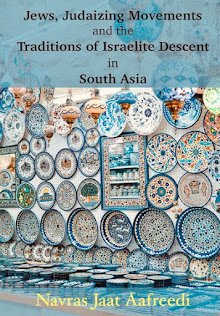
Dr. Navras Jaat Aafreedi with his e-book (CD-Rom)


Acclaimed Urdu poet and writer Anwar Nadeem (b.1937), an Afridi Pathan from Malihabad

The great Urdu poet Josh Malihabadi (1898-1982), an Afridi Pathan from Malihabad and recipient of India's third highest civilian award, the Padma Bhushan


An Afridi Pathan family of Malihabad, India

by Farzand Ahmed, India Today, November 6, 2006


A recent study has traced the origin of Afridi Pathans in a small town of Uttar Pradesh to the biblical 'lost tribes' of Israel. But the Pathans are not ready to accept themselves as Jews.

Malihabad, the small orchard town on the outskirts of Lucknow, will appeal to your senses straightway. While it is renowned for the sweet and fragrant Dussheri mango, the place has given birth to some of the finest Urdu and Persian poetry. And its claim to fame does not end there. The dusty town now stands home to something which can be traced back to biblical times. Among the inhabitants of Malihabad are a clan of tall, fair, well-built people who call themselves Afridi Pathans-warrior and poets. In fact, a huge arch at the entry to the town is dedicated to Bab-e-Goya, a famous warrior and poet. Growing evidence, however, suggests that their ancestry is not Muslim but Israelite and they are not originally from the Afghanistan-Pakistan area but are, in fact, one of the 'lost tribes' of Israel. In Malihabad, in the heart of Uttar Pradesh, they certainly stand out with their unique physical features.

Now a study by one of their own tribe, Navras Jaat Aafreedi, and published recently in the form of an e-book titled The Indian Jewry & The Self-Professed 'Lost Tribes of Israel' in India traces their lineage to one of the 'lost tribes' of Israel. Says Navras, "The main purpose of the research (for a doctorate from Lucknow University) was to trace the Afridi Pathans' ancestry." To make his study credible, he got help from an international research team which included Professor Tudor Parfitt, director of the Centre of Jewish Studies, London University and Dr Yulia Egorova, a linguist and historian from Russia. The team visited Malihabad and collected DNA samples from 50 paternally unrelated Afridi males to confirm their Israelite descent. The researchers looked at Israel's connections with Pathans in the Frontier areas of Pakistan and their links with Afridi Pathans in Uttar Pradesh's Malihabad and Qaimganj (Farrukhabad) as well as with Pathans in Aligarh, Sambhal and Barabanki besides tribes in Kashmir, Manipur and Guntur of Andhra Pradesh.

Historians and scholars like Professor S.N. Sinha, former head of the department of history, Jamia Millia Islamia and Professor V. D. Pandey, head of the department of medieval and modern Indian history, Lucknow University, have found Navras' research a 'landmark' study on the Jews in India and their links to Uttar Pradesh. According to the Bible, there were 12 tribes of Israel. The northern kingdom consisted of 10 tribes who were exiled and subsequently considered 'lost'. Four of 'lost tribes' have been traced in India: the Afridis, the Shinlung in the Northeast, the Yudu in Kashmir and the non-Muslim tribes in Guntur. Historians believe that Afghans were the descendents of Israel - another name of Abraham's grandson Jacob or Yaqub. They came to the region known as North West Frontier and Afghanistan and as they moved onwards they were called Afridan, in Persian meaning 'newly arrived' and thus acquired the title 'Afridi'. Many of the Afridi-Afghans still follow Jewish tradition like Sabbath and circumcision on the eighth day of the birth. There are three major groups of Israelites or Jews in India: Bene Israel, which is the largest group, the Cochini, the smallest group and the Baghdadi. The Pathans of Malihabad and Farrukhabad call themselves Bani Israel, which means Children of Israel. Bani Israel clans are also found in Aligarh and Sambhal in Moradabad.

The Pathan-Afridi settlement in Malihabad dates back to 1202 A.D., when the village of Bakhtiarnagar was founded by Mohammad Bakhtiar Khilji. Most of the Pathans came in around the middle of the 17th century and each migrant clan took possession of villages around Malihabad. However, the greatest wave of migrant Pathans, mainly Afridis, arrived in Malihabad a century later during Ahmad Shah Abdali's five invasions between 1748 and 1761.

Many Israelite-Afridis of Malihabad and Qaimganj rose to eminent positions in the field of warfare, politics, literature and sports. If Dr. Zakir Husain, an Israelite-Pathan, the third President of India and founder of Jamia Millia Islamia University hailed from Farrukhabad, Malihabad prides itself on Nawab Faqueer Mohammad Khan 'Goya', the poet and courtier of Awadh, Josh Malihabadi, the rebel poet who later migrated to Pakistan; Ghaus Mohammad Khan, the tennis player and Anwar Nadeem, stage artist, writer and poet.

There are around 1,200 to 1,300 Pathans in Malihabad and half of them, according to the latest research, are Israelite-Afridis. The study has evoked much excitement among the Afridi Pathans as they are not ready to accept their Jewish identity. Unlike the other tribes who have readily claimed affiliation to the 'lost tribes' of Israel, Afridi Pathans are sceptical about their Jewish status. The reluctance is quite evident as 91-year-old Qavi Kamal Khan, one of the Afridi Pathans of the town, says, "I have heard that we have Israelite lineage but we are not Jew. We are are Afridis." Historians, however, believe that Navras' research may turn out to be a milestone in the genealogical-historical research that takes off in an obscure of Lucknow, re-discovering a link lost in the passage of time. The study, for once, proves that the world is, in fact a global village.


Is Muslim clan the lost tribe of Ephraim?

Dr. Navras Jaat Aafreedi (second from right) with Bollywood actors Farouk Sheikh and Shabana Azmi (left) and the Governor of the Indian state of Haryana, Dr. A. R. Kidwai (extreme right) at the release of his e-book, on June 12, 2006, at the International Literary Festival in Lucknow, India


Indian historian finds genetic material common to Pathans, Jews

Dr. Navras Jaat Aafreedi, an Indian historian, says he may have found a genetic link between members of his clan in northern India, the now-Muslim Afridi Pathans, and one of the Ten Lost Tribes."

There were those who looked at this research as part of a big Zionist conspiracy against Islam," said Aafreedi, who is currently conducting research at Tel Aviv University into possible Israelite descent among certain Muslim Indian groups. "They felt I was trying to deprive Islam of its bravest followers, the Pathans, by converting them to Judaism. They felt that my convincing them of their Jewish heritage was just another form of conversion."

According to Aafreedi's study, which was published as an e-book, about 650 out of the 1,500 members of the Afridi Pathan clan in Malihabad, India, may possess genetic material shared by nearly 40 percent of Jews worldwide. If confirmed, the findings would support the clan's connection to the tribe of Ephraim, Aafreedi said. A related Indian Pathan group numbering some 800 people was not tested for the project.


Although he performed the research for his doctoral studies at Lucknow University, the main motivation for Aafreedi's research was personal."My uncle told me when I was a child about our connection to the Israelites," he said.


He has been deeply interested in his ancestry ever since, especially in "the fact that the tribe is identified with Israel."Aafreedi describes himself as a secular humanist with no bias against Jews, but says such open-mindedness is not common in his clan."The new generation of the Pathans is largely ignorant," he said, adding that after settling in a "hostile Muslim environment," the Pathans largely lost their own traditions."The knowledge of our ancestry was passed down orally, he said. "But now only the elders know about it."


According to Michael Freund, a Jerusalem Post correspondent and chairman of Shavei Israel, a Jerusalem-based group that assists lost Jews seeking to return to the people of Israel, this assimilation comes as no surprise."With the rise of Islamic fundamentalism in that part of the world over the decades, an attempt has been made to erase any trace of their [the Pathan's] Jewish connection," Freund said.


Aafreedi agrees. "They have been affected by the yellow journalism of Muslims in India, and it has shaped their political outlook. The Muslim press is usually anti-Jewish and anti-Israel," he said.Claims of Jewish heritage are nothing new in India. Historians believe that that at least two groups, the Shinlung (Bnei Menashe) in the northeast, and the non-Muslim tribes in Guntur, share Jewish ancestry. In addition, experts say evidence exists linking the Afridi Pathan tribe outside of India to the ancient Israelites."


Historically, there were Persian writers who wrote about the connection between the Pathans and the people of Israel," said Freund. "When the British arrived in the area there were missionaries who wrote about it as well. There is quite a good deal of historical evidence to support this assertion."Even former president Yitzhak Ben-Zvi addressed the connection. In his book, The Exile and Redeemed, he quoted an Afghani Jew as saying, "


According to the tradition current among the [Afghan] Afridis, they are indeed descendants of the Israelites, more particularly the sons of Ephraim." There are an estimated 40 to 50 million Pathans, mostly in Pakistan and Afghanistan.Aafreedi's research is now being analyzed by geneticists in England. If his results are confirmed, it will be the first genetic evidence linking the Afridis Pathan tribe to the Israelites.


There are some who doubt a genetic connection could provide genuine proof of Jewish lineage."There's no such thing as Jewish DNA," said Post contributor Hillel Halkin, author of Across the Sabbath River: In Search of a Lost Tribe of Israel, which discusses the issue of an ancient Israelite migration to India. "There is a [genetic] pattern which is very common in the Middle East, and 40% of Jews worldwide have it. But many non-Jews and people in the Middle East have it also," he said.•


Citation from the Maulana Azad Memorial Academy, Lucknow, India

Dr. N. J. Aafreedi (centre) being felicitated by the Advocate General of the Indian state of Uttar Pradesh, Mr. S. M. A. Kazmi (right) and the General Secretary of the Maulana Azad Memorial Academy, Dr. A. Q. Hashmi (left)
Dr. Navras Jaat Aafreedi


It gives Maulana Azad Memorial Academy immense pleasure to felicitate Dr. Navras Jaat Aafreedi for his remarkable contribution to Indo-Judaic Studies. The world's only serious researcher of Muslims of Israelite descent in India, he is the biggest contributor of research papers on Afridi Pathans. His e-book, titled The Indian Jewry and the Self-Professed 'Lost Tribes of Israel' in India, which embodies his doctoral (Ph.D.) thesis, is the first book to combine the study of the non-Jewish claimants of Israelite descent in India with that of the Indian Jews, and the third major work ever by a non-Jew on the lost tribes of Israel. Dr. Aafreedi is also the first writer to make any worthwhile contributions to Jewish Studies in the Urdu language. His writings have, in their own small way, helped to ease tensions between Jews and Muslims, who are sadly seen as natural adversaries today. The academy greatly appreciates Dr. Aafreedi's devotion to the task of getting Indo-Judaic Studies recognised as an academic discipline in universities, and wishes him all the best for his future endeavours.

Dr. A. Q. Hashmi, Secretary and S. M. Nasim, President
10th October, 2006

Tracing Jewish Links in Malihabad

Dr. Navras Jaat Aafreedi at his Ph.D. convocation at Lucknow University, India
Great Urdu poet Josh Malihabadi, an Afridi from Malihabad, India
Times News Network, The Times of India, Lucknow, August 10, 2005
Lucknow: DNA tests of 50 paternally-unrelated Afridi Pathan males of Malihabad are being conducted at the School of Oriental and African Studies (SOAS), London University. The results of which are expected to be here soon and will come handy in deciding whether they have an Israeli lineage or not. However, Navras Jaat Aafreedi, a research scholar at Lucknow University strongly believes that these Afridi Pathans, who had come from the Khyber tribe of the North West Frontier, now in Pakistan, have a Jewish lineage.

Navras came to this conclusion after three years of extensive research titled "The Indian Jewry and the Self-Professed 'Lost Tribes of Israel' in India", for which Lucknow University has also awarded him the degree of Doctor of Philosophy in History. Navras, who himself belongs to Malihabad, started working on this research project in November 2002, under the supervision of the head of Medieval & Modern History Department, Prof. V. D. Pandey. "It is an effort to trace my own roots," says Navras, as he narrated how he went through the entire study, spending hours in History books, searching for facts and clues, which could help in his research. "I was all of 12, when my uncle first told me that our family could be having a Jewish lineage," he said. He decided at that very moment that one day he would explore the truth. Navras formed a team with Prof. Tudor Parfitt, Chairman of the Centre of Near and Middle East Studies and Director of the Centre of Jewish Studies, SOAS, London University and Dr. Yulia Egorova, a linguist and historian from Russia. They went to Malihabad, where they collected DNA samples of Afridi Pathans in order to confirm their putative Israeli descent. Significantly, during the course of the study, the team interviewed hundreds of Afridi Pathans in Malihabad and learnt that most of them were ignorant of their Israeli descent.Navras explained that when Afridi Pathans came to Malihabad they did not disclose their Jewish lineage due to the fear of being isolated in the pre-dominantly non-Pathan Muslim society. As a result, the word was not passed to the coming generations and subsequently, they were left ignorant of the historical fact. "Few of the illustrious Afridi Pathans India has seen, are the third President of India Dr. Zakir Husain, the great Urdu poet Josh Malihabadi and Ghaus Mohammad Khan, the first Indian to reach the Wimbledon quarter finals in 1939," he said. Navras also went to Aligarh along with Dr. Yesudian Storfjell, SOAS, London, and visited the Mohalla Bani Israilan and interviewed the District Qazi of Aligarh, Muhammad Ajmal, who was not shy of admitting that he belonged to the clan of Bani Israel there, which is believed to have descended from a Jewish sahabi (companion of Prophet Mohammad), and came to India to spread the message of Islam around one-thousand years ago. He also took part in discussions with Prof. Jay Waronker, School of Architecture, North Dakota State University, authority on Indian synagogues, and Dr. Shalva Weil, an anthropologist from the Hebrew University of Jerusalem and author of India's Jewish Heritage. In March this year, he also did an assignment for a London University project, titled "Representation of Jews, Zionism and Israel in Pakistani and Indian Muslim Discourse", funded by the Arts & Humanities Research Board, UK.