This blog is a collection of stories that have appeared in the press in different languages, countries and continents on Dr. Navras J. Aafreedi's research on Indian Jews and those in South Asia who consider themselves or are considered by others to be descendants of the Lost Tribes of Israel and his efforts to raise Holocaust awareness.
Since the first decade of the 21st century, a young Indian scholar of Muslim origin, Navras Jaat Aafreedi of Gautam Buddha University [now employed with Presidency University, Kolkata], has been fighting against Holocaust ignorance and denial in India. For example, in 2009, he organized the screening of dozens of movies about the Holocaust on the campuses of the two largest universities of Lucknow, a city notorious for its anti-Israel demonstrations and Muslim anti-Semitic discourse. Prominent Indian figures and intellectuals, many of them Muslims, came to address an audience of over 4,000 people and spoke out against anti-Semitism and Holocaust denial.
- Shalom Salomon Wald and Arielle Kandel, India, Israel and the Jewish People: Looking Ahead, Looking Back 25 Years after Normalization, The Jewish People Policy Institute, Jerusalem, 2017, p. 138.
For a long time, the only course taught about Israel at an Indian institute of higher education was that of Professor Kumaraswamy at Jawaharlal Nehru University in New Delhi. More recently, Navras Jaat Aafreedi, the Indian Holocaust scholar mentioned above, has also begun to promote Jewish and Israeli studies."
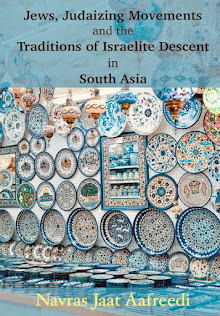
Navras Jaat Aafreedi. 2016. Jews, Judaizing Movements and Traditions of Israelite Descent in South
Asia. New Delhi: Pragati Publications, Pp xxiv, 124. ISBN
978-81-7307-158-6 (Hardback).US $26.95
This book is based upon the doctoral
dissertation of Navras Jaat Aafreedi, a historian who has distinguished himself
by seeking to make Indians and Pakistanis, especially those of Muslim heritage,
more aware of, and sympathetic to, the history of Jews in India, the Holocaust,
Jewish practices and perspectives. In a country where “Hitler” is today often
given as a name to children, and where the dictator is admired as someone who
could instil order and discipline, Aafreedi’s efforts to bring to Indians an
understanding of the Nazis’ attempt to implement a “final solution” to the so-called
“Jewish problem” are imporant. Ironically, these attitudes subsist in a
population generally not ill-disposed to Jews, but are rather for the most part
unfamiliar with Jews and their sensitivities. In this context, Aafreedi’s sympathy
for Jewish concerns is greatly appreciated.
India’s vast population has
included no less than three minuscule Jewish communities, and in recent years
it has also seen the rise of new Judaising movements, groups who have come to
adopt some form of Judaism, either out of a belief that they have Jewish or
Israelite origins, or a conviction that Judaism is the “true” religion. In
addition, as Aafreedi shows, there are also a number of communities in India,
Pakistan and Afghanistan who have traditions of Israelite descent, among them
his own Afridi Pathan patrilineal clan. Whereas there have
been many studies concerning the Jewish communities in India, and in recent
years the Judaisers, there have, to the best of my knowledge, not been any
other works that have included communities with traditions of Israelite descent
alongside the other two categories. Here, Aafreedi has essentially broken new
ground, drawing attention to these groups, for people with an interest in the
Jews of India.
Aafreedi devotes a chapter to
each of these categories. Chapter 1 covers the three historical Jewish
communities in India: the Bene Israel from coastal Maharashtran villages south
of Bombay (Mumbai), the Jews of Cochin (Kochi) in Kerala, and the Baghdadi Jews
who were settled predominantly in Bombay and Calcutta (Kolkata).
The origins of the Bene
Israel and Cochinis are shrouded in mystery, both communities having been
settled in India for hundreds, if not thousands, of years. The Bene Israel were
historically scattered in villages of the Konkan coastal region, where they had
a caste-like occupation as producers of sesame oil, the main cooking medium in
western India. The fact that they did not work on Saturdays earned them the
name “Shanwar Telis”, Saturday Oilmen (p. 5). Although they had very little
Jewish knowledge, they knew enough to maintain kosher dietary restrictions, and
they practised group endogamy, in keeping with Jewish traditions and the Indian
caste system.
From the eighteenth century,
Bene Israel began to settle in Bombay, where they were eager to learn more
about Judaism through contact with Baghdadi and Cochini Jews, and ironically
through western Christian missionaries, who translated the Bible into the Bene
Israel’s Marathi language and taught Hebrew. The Bene Israel were grateful for
what the missionaries had taught them, but very few of them adopted
Christianity.
Aafreedi devotes almost four
pages (pp. 2-5) to the issue of recent genetic testing of Bene-Israel, whose
Jewish ancestry had long been called into question, but their claims now seem
to have been vindicated, through studies (quoting Waldman) “which demonstrate
that the community is genetically more similar to other Jewish communities than
are all the Indian and Pakistani communities”. Many Bene Israel apparently
display the “Cohen modal haplotype”, common among Jewish Cohanim. Aafreedi
quotes the researcher Tudor Parfitt, that this “leaves just a billion to one
chance of a mistake in identifying who the Bene Israel really are” (p.4).
Whereas the Bene Israel had
only vestigial knowledge of Judaism until modern times, the Jews of Cochin were
always able to maintain connections with the rest of the Jewish world and
maintained orthodox practices. They have had a distinguished past, with one
King Parkaran Iravi Vanmar having bestowed upon a certain Joseph Rabban the
village (or city) of Anjuvanam (also known as Cranganore) in perpetuity, along
with various hereditary privileges, enumerated on copper plates, inscribed in
three languages (see page 8 for an English translation). During the fifteenth
and sixteenth centuries, the Portuguese harassed the Jews, on account of their
religion, and as rivals in the pepper trade. In 1564, the Portuguese attacked
Cranganore, which by then had been in a deteriorated state. The Jews who fled were
welcomed and given shelter by the Raja of Cochin, who allocated to them land
adjacent to his palace to build the Pardesi Synagogue (p.11), which celebrated
its 400 hundredth anniversary in 1968 (p.41).
The “Baghdadi” Jews, hailing
from Iraq and other countries of the Middle East, began to establish themselves
in India late in the eighteenth century. A mercantile community, they prospered
under British rule, and many sought to emulate the British. Over time, the
language of the community shifted from Arabic to English, as Baghdadis sent
their children to English language schools. Aafreedi observes “Hardly any
attempt was made to master any Indian language, though most Baghdadis became
acquainted with Hindustani of a simple sort” (p.14). Seeking acceptance from
the British rulers, they sought to distance themselves from “native” Indian
Jews, especially the Bene Israel.
Aafreedi’s next chapter looks
at the Judaising movements of the “B’nei Menashe”, a group from North East
India who have adopted Judaism out of a belief that they were descendants of
the biblical tribe of Manasseh, the “Bene Ephraim” from Andhra Pradesh who
assert descent from the tribe of Ephraim, and members of “the Chettiar
community of Erode in Tamil Nadu” (p.21).
The B’nei Menashe have been practising
Judaism since the 1970s and many have come to be accepted as orthodox Jews
after undergoing conversion in Israel, thanks to the support initially of Rabbi
Eliyahu Avichail and his Amishav organisation, and later by Michael Freund and the
organisation called Shavei Israel. Several thousand have settled in Israel
since 1989 (p.17). In 2005, attempts to formally convert B’nei Menashe to
Judaism in India created a diplomatic incident between India and Israel (p.17).
The Bene Ephraim are a more
recently emerged group of 125 families, who come from a Harijan/Dalit caste
background (p.21). Subjected to harsh discrimination from caste Hindus, the
assertion of an Israelite past is hopefully a means to a more respectable
status. This group takes its lead from the college-educated members of the
Yacobi family. However, because of the poverty and lack of education of their
followers, most have very limited Jewish knowledge.
The Chettiars only embraced Judaism in 2011, “when 1500 congregants
of the Zion Gospel Church abandoned Christianity for Judaism under the
leadership of their pastor Samuel Devasahayam and renamed the church Zion Torah
Centre” (pp.21-22), and they have a dream of settling in Israel to help “make
the desert bloom”. An urban community without experience in agriculture, they
have purchased farmland growing coconut trees, to practise farming and so to
prepare them for their prophetic dream (p.22).
These 3 Judaising groups, as diverse as they are, had all been
practising Christians before adopting Judaism. By contrast, the communities
with a long tradition of Israelite origins are predominantly Muslim and do not
show signs of wishing to revert to their putative ancestral religion. Indeed,
we learn that “they are so strongly anti-Zionist and anti-Israel and also
greatly prejudiced against Jews” that they are not interested in migrating to
Israel (p. 25). Apart from the tradition of Israelite origin of the Pathans and
similar claims about Kashmiris (pp. 29-31), there are assertions that the kings
of Afghanistan were descendants of King Saul in the Bible (pp. 25-26). Several Muslim
groups who are known as “Bani Israil” – children of Israel, are said to descend
from a Jewish-born companion of the Prophet Muhammad, while the Qidwais,
believe their progenitor, a Sufi mystic of the twelfth century called Qazi
Qidwa had been a Jew (p.24).
One group with a postulated Jewish ancestry who are not Muslims are
the Kananya or Thomasite Christians, an ancient, Syrian-Orthodox community in
Kerala, close to the Jews of Cochin, apparently around 200,000 in number. They
are reputedly endogamous, use Aramaic in their liturgy, and have customs and songs
which resemble those of the Jews in the area (pp.36-38).
From Chapter 4 onwards, the book looks only at the Jews of India,
with no further exploration of the Judaisers or communities with claims of
Israelite descent. Aafreedi focuses on the history of synagogues in India, Jews
in Indian cinema and literature, Jewish-Muslim relations, and Indian Jewry in
Israel. These are essentially distinct essays, interesting in themselves, but
not woven together to create a consistent narrative.
Aafreedi is clearly passionate about the cinema and provides a
fascinating expose of the role that Jews, particularly Baghdadi women, played
in the early years of Indian film, and in beauty pageants. In part this may
have been due to their generally lighter complexion than true Indian women, but
after the end of the silent movie era, those who could not deliver lines in an
Indian language lost their appeal.
Aafreedi sees the Baghdadi women as “the first to be bold enough to
act in films, braving all the risks involved to their reputation and otherwise
when even the prostitutes shied away from acting in films (pp.53-54).” “Highly
Westernised in their lifestyle and outlook”
… they did not have the reservations that women from other
communities in India, including the other Jewish communities, the Bene Israel
and the Cochini (resident in India for a much longer time than the Baghdadis),
had when it came to indulgence in performing arts. By doing so they paved the
way for women from respectable families from other communities to follow suit
(p.54).
As impressive
and heroic as this may seem to be, it is noteworthy that in effect these
heroines of the silver screen had thereby cut themselves off from their native
communities, breaking the Jewish taboo of marrying out of the faith, most of
them taking Muslim husbands. As liberated as these women may have been, it
would seem that either their Baghdadi communities were not in tune with them,
or that having shed the inhibition of putting oneself in the public view, other
restrictions no longer mattered to them.
I enjoyed the chapter on Jews in
Indian literature, with the culturally informed analysis that Aafreedi is able
to offer. Nissim Ezekiel’s poetry is powerful and reveals the Jewish cultural
heritage that he carries as a Bene Israel. Short story writer Sophie Judah’s
reflections on the way that reading the
Diary of Anne Frank when she was 10 or 11 sparked a keen interest in
searching for books on Judaism struck a chord with me, coming as I do from a
Jewish community not in the mainstream in Western society. As she recalled:
All the books I found were written about the Jews of Eastern Europe
or America. There was nothing about us.
On the library shelf, there were some books about the Bene Israel,
but it was all anthropology. They’re looking at you through a microscope: “Are
you Jewish, aren’t you Jewish: this tradition, that tradition.” And then the
history. But there was no humanity, the human touch was missing (p.73).
I was delighted
to see a reference to “a short-story writer named Moses Aaron who is based in
Australia” as apart from Jael Stillman, the only writer to have emerged from
the Baghdadi Jewish community of Calcutta (p.74), but disappointed that
Aafreedi did not specifically mention or analyse any of his works. I was also
irritated, I must admit, with the attention that Ruth Prawar Jhabwala received
in two chapters of the book, with much the same information appearing in the
chapter on cinema and the chapter on literature. As impressive as she is in
both media, and taking account that she did not have an Indian heritage, it
would have been preferable if her work could have been discussed in the one
place.
I found the chapter on relations
between Jews and Muslims in South Asia uncomfortable reading, as more than half
the chapter concerns Jews who converted to Islam, notably the seventeenth
century Sufi poet Sarmad, along with several Mediaeval figures, and Leopold
Weiss who took on the name Muhammad Asad after his conversion to Islam - a
brilliant scholar and Pakistani diplomat. I do not see this as relations
between Jews and Muslims, except to the extent that we might learn how these
men, as Muslims, view their former coreligionists. While there have been
instances of mutual respect and cordial relations, and it is heartening to
learn of Khurshid Imam who teaches Hebrew at the Jawaharlal Nehru University,
and a Muslim, Thoufeek Zakriya who practises Hebrew calligraphy, Aafreedi also
highlights increasing hostility to Jews, based on opposition to the existence
of the State of Israel, and ostensibly religious grounds.
Most
of the Jews of India have left the country, even though they retain a deep love
for it, and many travel back to visit. The final chapter treats the situation
of Indian Jews in Israel, where most of the Cochini Jews and the Bene Israel
have now settled. The chapter is well written and deals sympathetically with
its subject, particularly with an extensive examination of the fight that the
Bene Israel endured to be recognised as equal to all other Jews in the Jewish
homeland.
The
Cochinis are presented as having had a more pleasant adjustment to life in
Israel, “having integrated completely in an alien environment” (p.98). Although
they had been an urban community, in Israel they were placed on agricultural
settlements, where, Aafreedi quotes Shalva Weil, “they became rich” (p.89). This
contrasts starkly with the assessment of Ginoo Zacharia Oommen, an
anti-colonial Christian from Kerala, in the book Ethnicity, Marginality & Identity: the Jews of
Cochin in Israel (New
Delhi: Manak Publications, 2011). Oommensees the Cochinis as a marginalised,
isolated group, subject to racial prejudice in Israel. It would be interesting
to see which of these perspectives is a more accurate representation of the
reality.
While
today there are an estimated 5,000 Jews in India, around 80,000 Indian Jews live
in Israel (pp. xiv, 85). Over time, as the migrant generation passes, it will
be interesting to see the extent to which their descendants maintain their Indian
languages and distinctive traditions, as also the extent that new Jews – the
Judaising communities - will bring a new lease of life for Judaism in India.
Myer
Samra
Australian Journal of Jewish Studies, Volume XXIX, 2015 - 2016, pp. 187-193.
The first book ever to combine the socio-historical-cultural study of the three Jewish communities of India, viz., the Bene Israel, the Cochini and the Baghdadi, the three Judaizing movements that emerged in India during the last seventy years, viz., the B'nei Menashe of Manipur and Mizoram, the B'nei Ephraim of Andhra Pradesh and the Chettiars of Tamil Nadu, and the traditions of Israelite descent among certain sections of Muslims and Christians in South Asia and the Jewish response to those traditions.
“Whereas there have been many studies concerning the Jewish
communities in India, and in recent years the Judaisers, there have, to the
best of my knowledge, not been any other works that have included communities
with traditions of Israelite descent alongside the other two categories. Here,
Aafreedi has essentially broken new ground, drawing attention to these groups,
for people with an interest in the Jews of India.”
- -
Myer Samra, Australian Journal of Jewish Studies
“The book provides an unusual set of perspectives
to view the Jews of India and those who claim affinity with Israel or the
Jewish faith.”
- Dr. Jael Silliman
"One of the most widely discussed works on the lost tribes of humanity in recent times."
- Vidya Pandit, Education World
"Historians...believe that Navras' research may turn out to be a milestone in the genealogical-historical research that takes place in an obscure corner of Lucknow, rediscovering a link lost in the passage of time."
- Farzand Ahmad, India Today
"A comprehensive and perhaps a landmark study of the Jews in India."
- Prof S N Sinha, Emeritus Professor, Allahabad University and Former Head, Department of History, Jamia Millia Islamia
"...a significant work of reference, and throughout is most interesting and written in elegant and lucid style. It is a welcome contribution to the field of Indo-Judaic Studies, and fills a lacuna in our sketchy, often shadowy knowledge of the Indian Jews and the claimants of Israelite descent in India."
- Professor K P Mishra, Former Pro-Vice Chancellor, University of Gorakhpur
"An admirably lucid and elegant account of the history of Indian Jews and those groups who profess to have descended from the 'Lost Tribes of Israel'."
- Professor V D Pandey, Former Head, Department of Medieval & Modern Indian History, University of Lucknow
“…A successful attempt at discussing the history of Jews in India, and in
initiating a dialogue for introducing Indo-Judaic studies in Southasia. A
pioneering work, introducing Indian Jewry to the world of academics, Aafreedi
lays the first stone for further research in the field of Jewish History in
Southasia.”
-- Ambreen
Agha, Himal Southasian
"...research...has drawn wide appreciation..."
- Puja Awasthi, The Sunday Indian
Author: Since the publication of the book, its author Dr Navras Jaat Aafreedi has joined Presidency University in Kolkata as Assistant Professor in History. Before that he taught at Gautam Buddha University for six years and four months as Assistant Professor in its Department of History & Civilization.
Order your copy today:
Vikas Kapoor
Pragati Publications
Vikas_Kapoor_1234@yahoo.co.in
Pragati Publications
4382/4B Ansari Road
Daryaganj
New Delhi - 110 002
Phone:
+91-7533 00 106 1
+91-7533 00 106 4
The book can be read online for as little as just ₹200/- (US$2.42 or GBP 2/- according to the current rate of currency conversion) here.
הבלוג הזה הוא אוסף של מאמרים שהופיעו בעיתונות בשפות,ארצות ויבשות שונות על מחקרו של ד"ר נברס ג'אאט אאפרידי על יהודים הודים ויהודים מדרום אסיה שנחשבים על ידי עצמם או על ידי אחרים להיות צאצאים של שבטי ישראל האבוים
This blog is a collection of stories that have appeared in the press in different languages, countries and continents on Dr. Navras J. Aafreedi's research on Indian Jews and those in South Asia who consider themselves or are considered by others to be descendants of the Lost Tribes of Israel and his efforts to raise Holocaust awareness.
Jews, Judaizing Movements and the Traditions of Israelite Descent in South Asia (2016)
Please click on the image above to read the book online.
Conceptualizing Mass Violence: Representations, Recollections, and Reinterpretations (Routledge2021)
Please click on the image above to access the e-book.
Time now to gorge on Mangoes!!!
-
*( Malihabad is a town 30 km from Lucknow (India). It is the mango belt of
North India and is internationally acclaimed for its mangoes. Among
different ...
Indo-Judaic Studies Scholar | Assistant Professor (History), Presidency University, Kolkata | Research Fellow, Institute for the Study of Global Antisemitism and Policy (ISGAP), New York | Salzburg Global Fellow | Visiting Research Scholar, Schusterman Center for Israel Studies, Brandeis University (July 2025 - July 2028)







 Posts

